
Musings

Thoughts on Design

Musings header image 1

Mortgage Payments

September 8th, 2014 · Uncategorized

Solutions for mortgage payments and maintenance can come in the form of a fixed-rate mortgage or a variable-rate mortgage. According to companies like SoFi, fixed-rate mortgages have a base rate, or interest rate, which sets the initial amount you have to pay every month, while variable-rate mortgages have a variable interest rate that affects how much you have to pay per month.

Everything You Need to Know About Choosing the Right Mortgage Lender - Sterling Homes Edmonton

Unlike a fixed-rate mortgage, a variable-rate mortgage allows you to change your interest rate throughout your mortgage term to get your loan term down to the shortest possible amount. Variable-rate mortgages also have a maximum amount they can pay at a given time, so if interest rates go up in the future, your monthly payment is based on that increase. Variable-rate mortgages are a good option for investors who can lock in a set interest rate and not pay more than they are comfortable paying for a fixed-rate mortgage.

Solutions for mortgage payments and maintenance can come in the form of a fixed-rate mortgage or a variable-rate mortgage. Fixed-rate mortgages have a base rate, or interest rate, which sets the initial amount you have to pay every month, while variable-rate mortgages have a variable interest rate that affects how much you have to pay per month. Unlike a fixed-rate mortgage, a variable-rate mortgage allows you to change your interest rate throughout your mortgage term to get your loan term down to the shortest possible amount. Variable-rate mortgages also have a maximum amount they can pay at a given time, so if interest rates go up in the future, your monthly payment is based on that increase. Variable-rate mortgages are a good option for investors who can lock in a set interest rate and not pay more than they are comfortable paying for a fixed-rate mortgage. Owner-occupied, single-family homes and condominiums are considered high-interest housing. Mortgage rates for these types of homes vary in different parts of the country and may depend on your zip code.

Before choosing a type of mortgage for your home, determine how much it will cost to pay back and determine if it will be easy to meet the debt-to-income ratio. If the affordability factor is strong, consider a fixed-rate mortgage. If your monthly payment is high, then you may want to consider a variable-rate mortgage.

What Is a Mortgaged House?

A mortgaged home is a fixed-rate loan for a particular purchase with a fixed-rate interest rate. If you are buying a home and want to keep it for the long term, you should consider an adjustable-rate mortgage, which is similar to a mortgage but has an adjustable-rate rate.

Your mortgage company will determine your loan amount and how much interest rate you’ll be on. Then, the lender will determine how much interest rate you’ll need to pay each month to keep the loan current, which is known as your mortgage payment. In addition to payment amounts, there may also be additional fees to consider when negotiating a mortgage loan, such as an origination fee and closing costs. This will be explained on the home inspection report.

On average, buyers need to borrow about 23% more on their home’s mortgage than the average borrower. The lender sets the mortgage rate, and the consumer decides how much he or she needs to borrow.
→ No CommentsTags:

Design Statement…

October 4th, 2009 · Thoughts on Design, Uncategorized

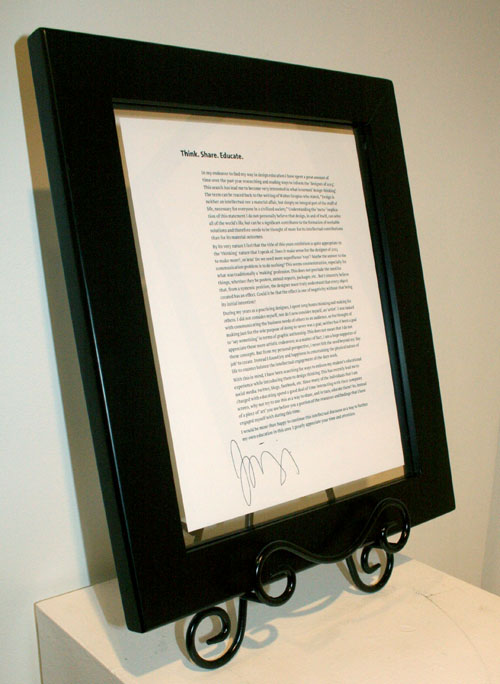
ArtStatementFor those of you who may have missed it we here in SAV just had a faculty show. I had a difficult time trying to justify this event so this is part of what I presented along with a print-out of my most recent twitter posts and accompanying printed links/site shares:


Think. Share. Educate.

In my endeavor to find my way in design education I have spent a great amount of time over the past year researching and reading ways to inform the ‘designer of 2015’. This search has lead me to become very interested in what is termed ‘design thinking’. The term can be traced back to the writing of Walter Gropius who stated, “Design is neither an intellectual nor a material affair, but simply an integral part of the stuff of life, necessary for everyone in a civilized society.” Understanding the ‘meta-’ implication of this statement I do not personally believe that design, in and of itself, can solve all of the world’s ills, but can be a significant contributor to the formation of workable solutions and therefore needs to be thought of more for its intellectual contributions than for its material outcomes.

By its very nature I feel that the title of this years exhibition is quite appropriate to the ‘thinking’ nature that I speak of. Does it make sense for the designer of 2015 to make more?, or less? Do we need more superfluous ‘toys’? Maybe the answer to the communication problem is to do nothing? This seems counterintuitive, especially for what was traditionally a ‘making’ profession. This does not preclude the need for things, whether they be posters, annual reports, packages, etc.. But I sincerely believe that, from a systemic position, the designer must truly understand that every object created has an effect. Could it be that the effect is one of negativity without that being its initial intention?

During my years as a practicing designer, I spent long hours thinking and making for others. I did not consider myself, nor do I now consider myself, an ‘artist’. I was tasked with communicating the business needs of others to an audience, so the thought of making just for the sole purpose of doing so never was a goal; neither has it been a goal to ‘say something’ in terms of graphic authorship. This does not mean that I do not appreciate these more artistic endeavors; as a matter of fact, I am a huge supporter of these concepts. But from my personal perspective, I never felt the need beyond my ‘day job’ to create. Instead I found joy and happiness in entertaining the physical nature of life to counter balance the intellectual engagement of the days work.

With this in mind, I have been searching for ways to enliven my student’s educational experience while introducing them to design thinking. This has recently lead me to social media: twitter, blogs, facebook, etc. Since many of the individuals that I am charged with educating spend a good deal of time interacting with their computer screen, why not try to use this as a way to share, and in turn, educate them? So, instead of a piece of ‘art’ you see before you a portion of the resources and findings that I have engaged myself with during this time.

I would be more than happy to continue this intellectual discourse as a way to further my own education in this area. I greatly appreciate your time and attention.

Please return for Part II of this thought, entitled “I am NOT an artist”.

→ 3 CommentsTags: ·····

Following up on a “tweet”

August 24th, 2009 · Thoughts on Design

Eye magazinesOk, so I’m finally getting a chance to sit down and write a reply to eye magazine about my tweet late last week. For those of you who missed that: “Yes, but this is a dated concept that has never caught on with business or designers. It is happening, ie. IDEO, Red Project.” This was in response to their tweet on their interview with Victor Margolin. I was asked by eye to elaborate.

Well, first of all I want to say how much I enjoyed the article and eye magazine in general (I own every issue but 3). My comment was not a critique of eye or the article itself but more about the timing of it. As I stated in my tweet, the discourse presented by Margolin in this interview is something both he and Richard Buchanan (see Wicked Problems in Design Thinking, Design Issues vol.8 no.2 ) have been teaching and writing about for at least 20 years now. It is only now that others are taking notice.

My general critique of the article is, why has it taken so long for eye magazine and others in the “mainstream” design press to catch on to this concept? (Design Issues has been leading the way here for some time.)

This argument, for design to look beyond artifacts, can also be traced back to Victor Papanek and his thoughtful writing, ‘Design for the Real World’. I certainly do not want to bore those who have read this with the details, but essentially Papanek rallies for designers to broaden their scope of ‘design’ beyond “persuading people to buy things they don’t need,…” In it he continues the argument started by Buckminster Fuller and others who believe that the designer has a responsibility to humanity and that by looking beyond artifact based outcomes, toward complex systems, our time and our discipline would become much more relevant.

As I also mentioned in my tweet there are those who are working in this thoughtful manner today and have been for some time. These firms/individuals do not get covered by design mags because what they do cannot, necessarily, be neatly categorized, i.e. Graphic Design, Industrial Design, etc. It is using the thinking of design to solve much more complex ‘problems’ (I guess ‘issues’ could be another term, ‘developments’…) IDEO, The Design Council (Red Paper 02).

I think that it is great to see that eye is presenting this material, I only wish that more designers would see the possibilities of their discipline and understand that what we were taught can be applied to so many thoughtful endeavors. Designers need to continue to push the discourse beyond ‘making’ so that the discipline can grow and be given more credence by business leaders, especially in these trying economic times.

This is where the education of the designer comes in to play; how does one ‘teach’ design and design thinking? Some of my colleagues here at SCAD and elsewhere are seeing the need for the designer of the future to not only understand the value of good typographic choices, colors, etc., but also to understand the need for collaborative efforts, systems thinking, user based research, and the like.

In closing, I hope that this clarifies my position. If not, I can pick up this post, (which I may do anyway since it is such a deep topic to cover).

Until next post?

→ No CommentsTags: ···

Welcome

August 22nd, 2009 · Uncategorized

utccapbooksMy first blog post and with so much that I wish to say it is hard to start, so I figured I would just start with a simple post, getting out all of the ‘junk’.

I hope to use this as a forum buycbdproducts design thoughts that I have been accumulating over the years and have never found the right place to discuss them. Some have been discussed https://buycbdproducts.com class, others have not. I will attempt to post something as often as possible, but in reality, if that turns out to be weekly, I will be more than pleased.

Thanks for stopping by.

PS. I can also be found at my web site: josephdigioia.com and on twitter: twitter.com/josephdigioia

→ No CommentsTags: ··